
To accept card payments in Ireland online, your business needs a payment gateway and PCI compliance; electronic transactions also require Strong Customer Authentication using two authentication methods.
That may sound like another admin job, but a straightforward checkout gives customers a familiar way to pay by card or digital wallet, whether they’re buying in person or paying an invoice online, while giving you a clearer view of payments received and less chasing after the work is done.
This guide explains how card payments work in Ireland, what online acceptance involves, and how security checks, settlement times and chargebacks affect everyday trading. You’ll also learn what to consider when choosing a payment method and keeping online transactions secure.
Key Takeaways
- Learn how in-store, mobile and online payment options fit different ways of doing business in Ireland.
- See what happens between a card tap and payment approval, including the role of contactless payments.
- Understand how card acceptance can make paying simpler for customers and reduce payment admin for your business.
- Explore how WaPay Payments can sit alongside invoices, bills and bookings to keep payment tasks together.
Table of Contents
Are there special requirements for online card payments?
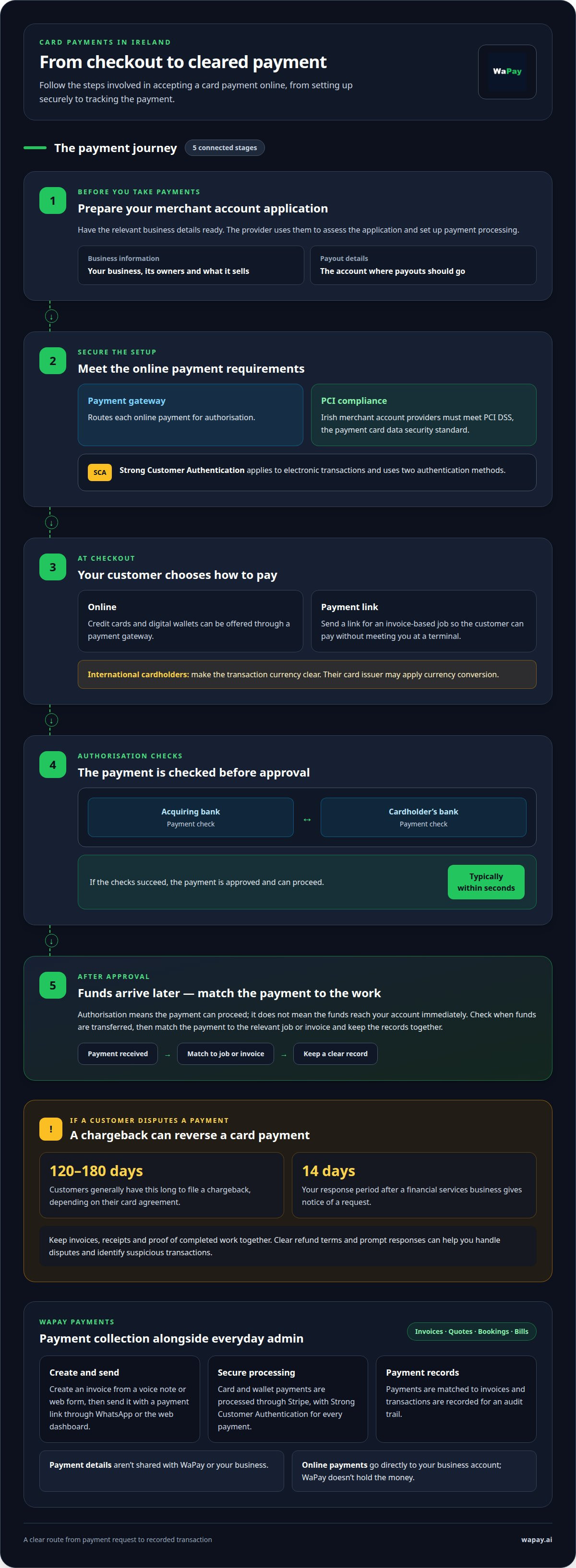
Yes. To take card payments online in Ireland, you need a payment gateway to route each payment for authorisation, and your setup must meet PCI compliance requirements. Strong Customer Authentication for electronic transactions uses two authentication methods. Irish merchant account providers must meet the PCI DSS payment card data security standard. These checks help protect card details during checkout.
For an Irish merchant account application, prepare details about your business, its owners, what it sells and where payouts should go. The provider uses these details to assess the application and set up payment processing. Keep relevant business records and payout account information to hand when completing the application.
Chargebacks can reverse a card payment after a customer disputes it. In Ireland, customers generally have 120-180 days to file a chargeback, depending on their card agreement. A business has 14 days to respond after a financial services business gives notice of a request. Keep invoices, receipts and proof of completed work together. Clear refund terms and prompt responses help you handle disputes and identify suspicious transactions.
In person, customers can tap contactless cards or use mobile wallets such as Google Pay. Online, credit cards and digital wallets offer familiar ways to pay through a gateway. Bank of Ireland is one example of a bank customers may use; the payment setup still needs to support the chosen card or wallet. Make the transaction currency clear for international cardholders.
Mobile ticketing is a separate use case. TFI Go serves public transport ticketing, while eligible TFI Local Link services accept Visa or Mastercard for single-journey tickets. Contactless payment is expected on all regular TFI Local Link services by the end of 2026. Trade businesses can offer customers payment options in person or online. A payment link can support online collection, alongside online payment options.
What Is Card Payment Processing in Ireland?
Card payment processing moves a customer’s payment from a card or phone towards your business account. At a terminal, the customer taps a contactless card or mobile wallet. The transaction is checked with the acquiring bank and the cardholder’s bank. If those checks succeed, approval typically arrives within seconds. A successful authorisation means the payment can proceed, though the funds reach your account later.
Debit cards dominate in-store purchases in Ireland, and contactless taps are standard. Contactless cards accounted for 84% of point-of-sale card transactions in 2023. Ireland also recorded 3 million contactless payments per day in the first quarter of 2023. For a tradesperson, a portable terminal lets a customer pay at the job rather than arranging a separate transfer.
Sole traders can accept cards without a monthly subscription by choosing a service with no recurring charge. Check the fee structure and when funds are transferred. Credit and debit card transactions may look alike at checkout, but both go through authorisation checks before approval.
TFI Local Link is a transport example of contactless use, distinct from a trade business taking payment for completed work. For eligible journeys, passengers can use contactless for single fares. International cardholders may also see currency conversion applied by their card issuer, depending on the card and account currency.
For an invoice-based job, a payment link lets customers pay without meeting you at a terminal. Send it after the work is complete and match the payment to the relevant job or invoice.
Benefits of accepting card payments
Card payments give customers another way to complete a purchase. A homeowner arranging a repair can pay when booking, while someone who approves a quote remotely can settle the invoice online. This flexibility helps when you’re travelling between jobs and can’t meet every customer in person. It also avoids arranging a separate cash handover.
For a trade business, payment options can fit different stages of a job. Take a card payment at the customer’s door after a call-out, or send an online payment link when the customer approves work by phone. This lets you collect payment without returning just to pick it up.
Card acceptance can also make the customer’s next step clearer. An invoice with a payment option gives them the amount due and a direct way to settle it together. That can reduce back-and-forth about how to pay, particularly for a customer managing household repairs alongside other commitments. Keep the job details and payment request clear so the customer knows which work the transaction covers.
There are limits to weigh. Card acceptance doesn’t guarantee a sale, and a customer may still choose another payment method. Treat it as an extra option, then decide where it helps most: at the point of sale, during a booking, or after work is completed. A simple payment routine should suit both the customer’s preference and the way you run each job.
WaPay: Payments
WaPay combines payment collection with everyday business admin. Create an invoice from a voice note or web form, then send it with a payment link through WhatsApp or the web dashboard. WaPay also supports quotes, bookings and bills.
Card and wallet payments are processed securely through Stripe, with Strong Customer Authentication for every payment. Payment details aren’t shared with WaPay or your business. Online payments go directly to your business account, and WaPay doesn’t hold the money.
This can suit sole traders who want customers to pay invoices online without adding payment follow-up to the end of a long working day. WaPay matches payments to invoices and records transactions, giving you an audit trail for tracking payments.
Contact WaPay to discuss how its payment tools could fit your business.
Make card payments fit your next step
If you’re preparing to accept card payments in Ireland, consider how each payment will fit into your everyday workflow. Decide where customers will pay, how payments will match completed jobs and how you’ll keep records up to date. A clear process can help keep payment admin manageable.
WaPay brings payments, invoices, bills, bookings and quotes together for everyday business tasks. Create an invoice, send a payment link and track transactions through the dashboard. With no subscription, you can register online and set up through WhatsApp.
Register online with WaPay to set up a payment routine that fits your business.
Frequently Asked Questions
How long does it take to receive funds from card payments?
Timing depends on the payment service and the banks involved. Irish businesses typically receive card payment funds within one to three working days. WaPay card payments settle in T+2 to T+7, depending on the bank. Check the settlement timing when planning cash flow, especially if you need funds available for materials or supplier bills after completing a job.
What Are Merchant Services Ireland?
Merchant services are the tools and processes that let a business accept and manage card payments. They can include payment processing, a terminal or online payment link, and arrangements for transferring funds. A tradesperson might take payment on site or send a link with an invoice. The right setup depends on where customers pay.
What fees and charges apply to credit cards?
Credit card acceptance can involve a payment fee for processing the transaction. The amount and structure depend on the service, card type and processing arrangement. Before choosing, look at how charges appear on statements, whether refunds affect fees, and how disputed payments are handled. For a business taking online payments, separate processing components may apply, so read the full fee breakdown.
What are the main ways for businesses to accept card payments in Ireland?
Businesses can take cards through a physical terminal, a mobile payment setup, or an online checkout or payment link. A tradesperson might use a terminal at a customer’s home, then send a link when an invoice is paid later. Card and wallet options can suit different customers. Choose the method around where the work is booked and completed.
Which card payment providers operate in Ireland and how do they compare?
Options include merchant services providers, online payment platforms and services connected to card processors. WaPay processes card and digital wallet payments through Stripe. Compare options by supported payment methods, settlement timing, fees, refund handling and how clearly transactions connect to invoices. For a small trade business, reducing manual payment matching can matter as much as the checkout itself.
Frequently asked questions
How long does it take to receive funds from card payments?
Timing depends on the payment service and the banks involved. Irish businesses typically receive card payment funds within one to three working days. WaPay card payments settle in T+2 to T+7, depending on the bank. Check the settlement timing when planning cash flow, especially if you need funds available for materials or supplier bills after completing a job.
What Are Merchant Services Ireland?
Merchant services are the tools and processes that let a business accept and manage card payments. They can include payment processing, a terminal or online payment link, and arrangements for transferring funds. A tradesperson might take payment on site or send a link with an invoice. The right setup depends on where customers pay.
What fees and charges apply to credit cards?
Credit card acceptance can involve a payment fee for processing the transaction. The amount and structure depend on the service, card type and processing arrangement. Before choosing, look at how charges appear on statements, whether refunds affect fees, and how disputed payments are handled. For a business taking online payments, separate processing components may apply, so read the full fee breakdown.
What are the main ways for businesses to accept card payments in Ireland?
Businesses can take cards through a physical terminal, a mobile payment setup, or an online checkout or payment link. A tradesperson might use a terminal at a customer’s home, then send a link when an invoice is paid later. Card and wallet options can suit different customers. Choose the method around where the work is booked and completed.
Which card payment providers operate in Ireland and how do they compare?
Options include merchant services providers, online payment platforms and services connected to card processors. WaPay processes card and digital wallet payments through Stripe. Compare options by supported payment methods, settlement timing, fees, refund handling and how clearly transactions connect to invoices. For a small trade business, reducing manual payment matching can matter as much as the checkout itself.