
The obvious payment option is not always the best fit. Choose a route that suits how your customers pay, when you need funds to arrive and how you keep records. Business payments to your bank account should follow a process that does not turn every invoice into another admin task, whether customers pay once or regularly. This guide explains how to set up payment routes in Ireland, compare bank transfers, standing orders, Direct Debits and online payment links, and weigh settlement timing against cash-flow needs. It also covers matching payments to invoices and keeping bookkeeping clear, whether you collect in person or send invoices remotely.
Key Takeaways
- Match bank transfers, standing orders and Direct Debit to how often customers pay and how much control you need over collection.
- Compare payment routes by settlement timing and how clearly each payment can be matched to an invoice.
- Set up a simple routine for recording incoming payments so your bookkeeping stays easier to manage.
- Choose a payment process that supports predictable cash flow without adding extra admin to your working day.
Table of Contents
Understanding bank transfers, standing orders and Direct Debit
Choose methods around payment frequency, currency and the control you need over collection.
Choose a business payment transfer option
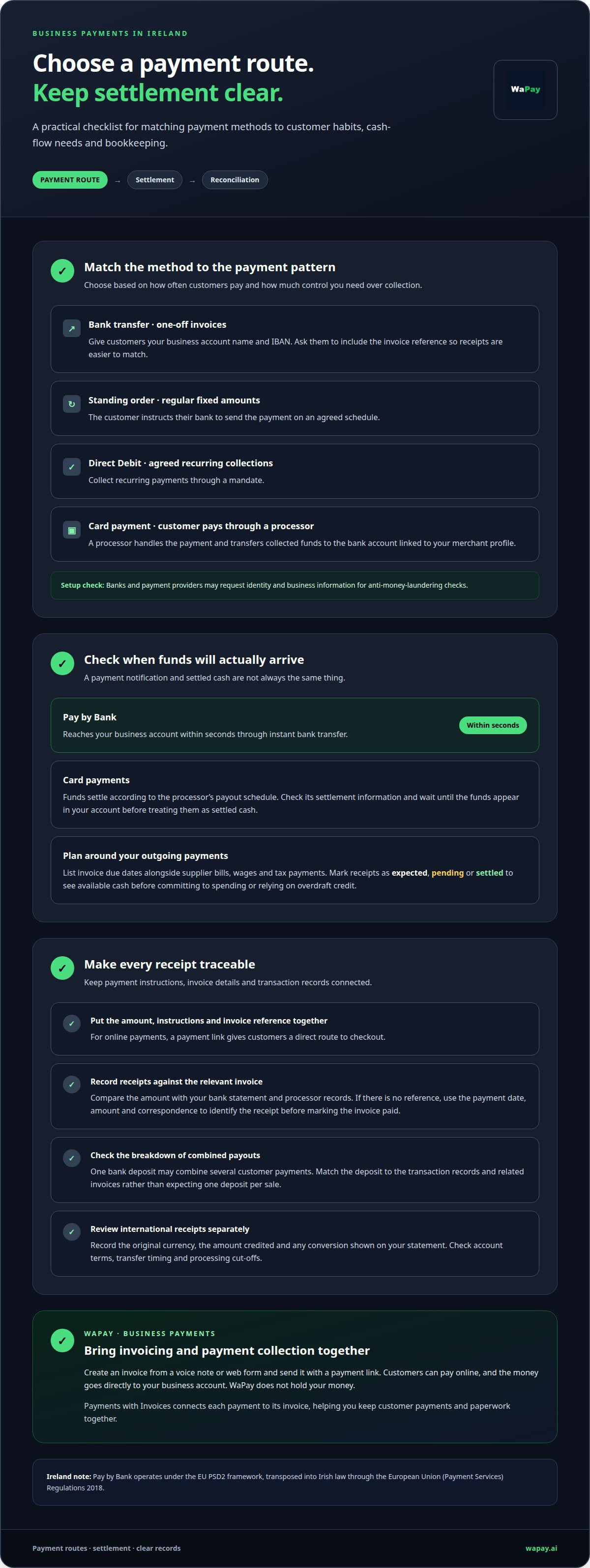
- Use bank transfers for one-off invoices. Give customers your business account name and IBAN, and ask them to include an invoice reference. This makes receipts easier to match. You can also offer business payment options for customers who prefer paying online.
- Use standing orders for regular fixed amounts. The customer instructs their bank to send the payment on an agreed schedule. Direct Debit suits agreed recurring collections through a mandate. Banks and payment providers may request identity and business information for anti-money-laundering checks.
- Reduce transfer mistakes and scam risks. Confirm any changed account details through a trusted contact route before sending money. Check the payment reference and recipient before approving a transfer. For card payments, keep transaction records so you can respond if a customer disputes a payment.
Check currencies, charges and arrival times
- Plan for overseas payments. A multi-currency account can help you manage receipts and supplier payments in different currencies. For example, record whether an international payment arrives in euros or another currency, then reconcile it against the invoice and account statement.
- Review account terms and transfer timing. Overdraft arrangements affect how much working capital is available. Bank transfer arrival times depend on the route and processing cut-offs; check your account activity against the payment date and reference.
- Understand the Irish Pay by Bank framework. According to the Irish Statute Book, Pay by Bank in Ireland operates under the EU PSD2 framework, transposed into Irish law through the European Union (Payment Services) Regulations 2018.
Cash flow and payment settlement
- Map expected income against outgoing payments. List invoice due dates alongside supplier bills, wages and tax payments. Mark each receipt as expected, pending or settled. This gives you a clearer view of available cash before you commit to spending or rely on overdraft credit.
- Separate payment approval from funds arriving. A card processor handles the customer’s payment, then transfers the proceeds to your linked Irish bank account according to its payout schedule. Check the provider’s settlement information, and do not treat a payment notification as settled cash until the funds appear in your account.
- Compare settlement methods with urgent costs. Pay-by-Bank payments reach your business account within seconds through instant bank transfer. Card payments settle according to the processor’s schedule, so allow for that timing when planning cash flow. Choose a method based on when you need access to the funds.
- Reconcile payouts against your statement. Match each bank deposit to the payment records and related invoices. A payout may combine several customer payments, so check its transaction breakdown rather than expecting one deposit per sale. Record any differences promptly to keep bookkeeping clear.
- Review international receipts separately. Note the original currency, the amount credited and any conversion shown on your statement. This makes it easier to spot timing or exchange-rate differences in your cash forecast. To put a simpler payment collection process in place, set up your business payments.
How can a business receive payments into its bank account in Ireland?
- Choose ways customers can pay. Offer bank transfers for invoice payments, standing orders for regular fixed amounts, Direct Debit for agreed recurring collections, or card payments through a processor. Match the methods to your sales. For example, a tradesperson may prefer bank transfers for one-off jobs and card payments for customers paying on site.
- Prepare payment instructions. Copy your receiving account details from your banking records and include them with each invoice. Ask customers to enter an invoice reference. This helps identify business payments to your bank account when several invoices have similar amounts or arrive close together.
- Set up card payment settlement. A processor handles the customer’s card payment and pays collected funds into the bank account linked to your merchant profile. Review its payout schedule and transaction records. These details help you match a combined deposit to the separate customer purchases it represents.
- Connect each payment with its paperwork. Put the amount due, payment instructions and invoice reference together. For online payments, a payment link gives customers a direct route to checkout. Keep payment confirmations with the relevant invoice, so you can trace business payments to your bank account without searching through old messages.
- Record receipts as they arrive. Enter each amount against its invoice, then compare the total with your bank statement and processor records. If a customer pays without a reference, use the payment date, amount and correspondence to identify it before marking the invoice paid. That keeps outstanding balances clear.
Consider costs and account requirements as part of your payment setup. A taxpayer registered for Revenue Online Service can set up a ROS Debit Instruction to register bank details for one-off and recurring payments.
WaPay: Business Payments
WaPay brings invoicing and payment collection together when chasing references and matching deposits takes time away from your work. Create an invoice from a voice note or web form, then send it with a payment link. Customers can pay online, and the money goes directly to your business account. WaPay does not hold your money.
Use Payments with Invoices to give customers a clear way to pay and connect each payment to its invoice. This can suit sole traders who send invoices on the go and want to avoid managing each step through separate messages and records. WaPay also includes Bills, bringing routine business paperwork into one workflow.
For a simpler way to send invoices and collect payments, contact WaPay.
Make your payment setup work for you
Choose a payment routine that fits how you work, then keep it consistent as your business grows. A good setup for business payments to your bank account makes it easier to connect each receipt with the work completed, without leaving a pile of admin for later.
WaPay’s team brings practical knowledge of how Payments, Invoices and Bills fit into everyday business admin. Use WaPay when you want to bring those tasks together and make sending invoices and collecting payments part of one straightforward workflow.
Take the next step towards a payment process that gives you a clearer view of what has been paid and what still needs attention.
Frequently Asked Questions
What does it actually cost to set up?
Register online and access WaPay through WhatsApp or the WebApp, with no app to download. Create an invoice from a voice note or text, then send the payment link to your customer. This gives them a clear route from invoice to payment. Keep the invoice record with the request to track the transaction in your bookkeeping.
What types of payments can be made online?
Customers can pay online by bank transfer, card, Apple Pay or Google Pay. For example, send an invoice payment link by email or SMS to a customer who does not use WhatsApp. They can open the link and choose an available method, while the payment record helps you match the receipt to the right invoice.
How long do business bank transfers take to arrive in Ireland and SEPA?
Pay-by-Bank payments reach your business account within seconds. Other bank transfer arrival times depend on the route and processing cut-offs, so compare your account activity with the payment date and reference.
What are the risks of payment scams, mistaken transfers, and chargebacks?
Scams or mistaken transfers can follow changed account details or a payment approved for the wrong recipient. Confirm changes through a trusted contact route, and check the recipient and reference before approving a payment. Customers may also dispute card payments, so keep transaction records.
Frequently asked questions
What does it actually cost to set up?
Register online and access WaPay through WhatsApp or the WebApp, with no app to download. Create an invoice from a voice note or text, then send the payment link to your customer. This gives them a clear route from invoice to payment. Keep the invoice record with the request to track the transaction in your bookkeeping.
What types of payments can be made online?
Customers can pay online by bank transfer, card, Apple Pay or Google Pay. For example, send an invoice payment link by email or SMS to a customer who does not use WhatsApp. They can open the link and choose an available method, while the payment record helps you match the receipt to the right invoice.
How long do business bank transfers take to arrive in Ireland and SEPA?
Pay-by-Bank payments reach your business account within seconds. Other bank transfer arrival times depend on the route and processing cut-offs, so compare your account activity with the payment date and reference.
What are the risks of payment scams, mistaken transfers, and chargebacks?
Scams or mistaken transfers can follow changed account details or a payment approved for the wrong recipient. Confirm changes through a trusted contact route, and check the recipient and reference before approving a payment. Customers may also dispute card payments, so keep transaction records.