In Ireland, issue a VAT invoice within 15 days of the end of the month in which you supplied the goods or services. To know how to send a VAT invoice, include the supplier’s and customer’s names and addresses, the supplier’s VAT registration number, a unique sequential number, the invoice and supply dates, a clear description, VAT-exclusive prices, and VAT shown by rate with the total due.
When you’re busy doing the work, invoice details and dates can easily slip. Getting them right keeps your records clear and gives customers the information they need.
This guide covers what to include, how invoice numbers and dates work, and when to issue an invoice. Follow these steps to handle the paperwork consistently and keep payment on track.
Key Takeaways
- Plan invoice issue dates around the end of the month in which you make the supply, so the deadline doesn’t catch you out.
- Make each invoice clear enough for your customer to identify the supply and understand how the VAT has been calculated.
- Keep invoice numbers sequential and unique, and distinguish the invoice date from the date the goods or services were supplied.
- Record advance payments carefully, as receiving payment before supply can affect when VAT is chargeable.
Table of Contents
Deadline for issuing a VAT invoice
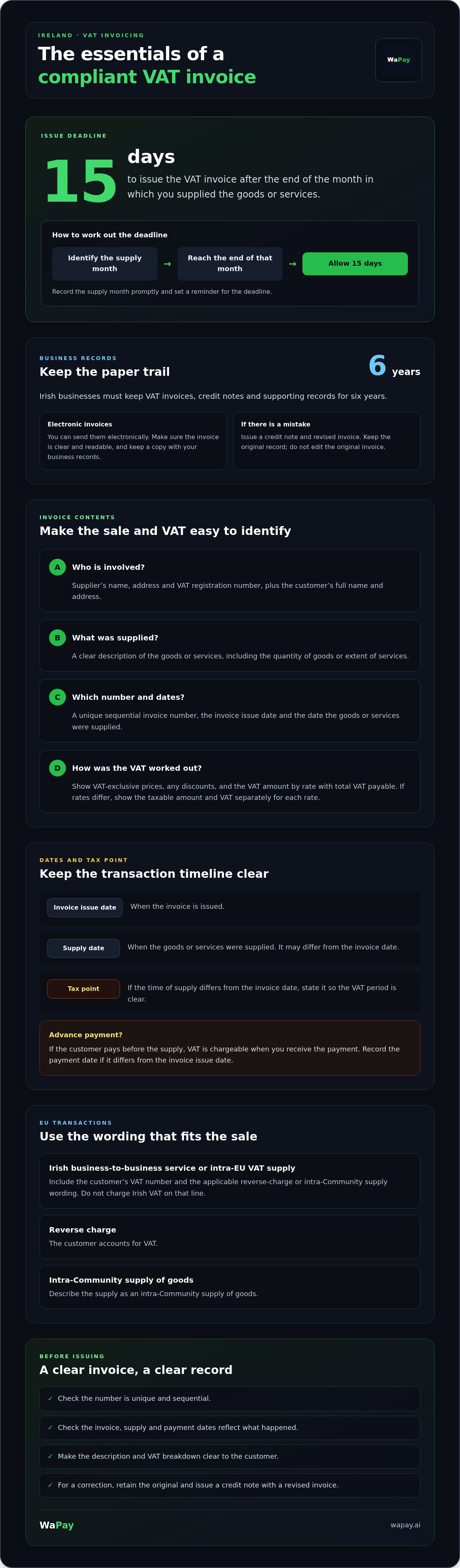
In Ireland, issue a VAT invoice within 15 days of the end of the month in which you supplied the goods or services. For example, if you complete a job in May, the deadline falls 15 days after May ends. To understand how to send a VAT invoice on time, record the supply month promptly and set a reminder for the deadline.
In Ireland, you can send a VAT invoice electronically. Send your customer a clear, readable invoice and keep a copy with your business records. This gives both sides a record of the charge and VAT without waiting for paper to arrive.
EU sales need careful treatment. For an Irish business-to-business service or intra-EU VAT supply, include the customer’s VAT number and the applicable reverse-charge or intra-Community supply wording. Don’t charge Irish VAT on that line. Under the reverse charge, the customer accounts for VAT. An invoice for an intra-Community supply of goods must also describe it as such. To send a VAT invoice for these transactions, use the wording that applies to the specific sale.
Correct mistakes with a credit note and revised invoice, rather than editing the original. Keep the original record and issue documents that clearly show the correction. Irish businesses must keep VAT invoices, credit notes and supporting records for six years.
Before sending, use this short deadline check:
- Identify the month the goods or services were supplied.
- Calculate the 15-day deadline from that month’s end.
- For EU transactions, add the customer’s VAT number and the relevant wording.
- If correcting an invoice, issue a credit note and revised invoice.
Definition of a VAT invoice
In Ireland, an accountable person issues a VAT invoice for a taxable supply. It records the sale and related VAT, helping establish the VAT liability on that supply. A VAT-registered customer can also use it to support a claim to reclaim VAT charged on eligible business purchases.
Make the transaction clear by including the supplier’s name, address and VAT registration number, along with the customer’s full name and address. Describe the goods or services, including the quantity of goods or extent of services. Show the supply date, VAT-exclusive prices, any discounts and the VAT amount.
If one invoice covers services taxed at different rates, show the taxable amount and VAT separately for each rate. This lets the customer see how each part of the charge was calculated, rather than relying on one combined VAT figure.
- Supplier and customer details
- Goods or services supplied, with quantity or extent
- VAT-exclusive prices and any discounts
- VAT breakdown by rate and total VAT payable
A VAT invoice is different from a receipt or pro forma invoice. A receipt records payment received; a pro forma invoice is preliminary and is not the final invoice for the completed supply.
Keep VAT invoices with your business records. A clear invoice helps customers match the charge to the supply and gives you a usable record of VAT reported on sales. Before sending, check each field, especially the description and VAT breakdown.
Invoice numbering, issue date and tax point
Give every full Irish VAT invoice a unique sequential number. A consistent sequence makes it easier to spot missing documents and match invoices to sales records. Use the next number in your sequence instead of reusing one from an earlier invoice.
Show the invoice issue date and record when the goods or services were supplied. These dates may differ. If the tax point, or time of supply, differs from the invoice date, state it too. This shows which transaction period the VAT belongs to.
Payment timing can affect the tax point. If a customer pays before you supply the goods or services, VAT is chargeable when you receive the payment. Record the payment date if it differs from the invoice issue date. For example, an advance payment received before a job starts may create a VAT time of supply on receipt.
There is no single penalty amount for every invoice error. The consequences depend on the breach and its effect on VAT accounting. An incomplete invoice can also make it harder for a VAT-registered customer to support a reclaim. Keep the issue date, supply date, payment dates and sequential number clear to reduce avoidable record problems.
Before issuing an invoice, check that its number is unique and its dates reflect the actual supply and payment timeline. Correct errors with a credit note and revised invoice, rather than changing the original document.
WaPay: Payments
WaPay helps make invoicing quicker. Use WhatsApp or the WebApp to create invoices and payment links from a voice note or text message, then send the details to your customer without preparing each document manually.
WaPay also supports payment reminders, VAT records and a live business dashboard, making key information easier to manage alongside everyday work. Customer payments go directly to your business bank account. With no app to download or subscription, WaPay can suit sole traders who want to manage invoices and payments alongside other admin.
For the practical next step, visit wapay.ai and explore how WaPay could fit your invoicing routine.
Make invoicing part of your working routine
Make invoicing part of the job, not an after-hours task. Build a repeatable routine around completed work: prepare the invoice, send it, then track its status. This handover from finished work to completed admin helps prevent paperwork from drifting.
Knowing how to send a VAT invoice gives you a sound starting point. A consistent process keeps customer communication and business records in step as your workload changes.
WaPay offers invoices, payments and bills to support everyday business administration. Explore how it could fit the way you manage invoicing.
Keep the process clear, finish the paperwork and give your attention to the next job.
Frequently Asked Questions
What information is required on a VAT invoice?
A VAT invoice needs enough detail to identify the seller, customer, supply and VAT charged. Include the supplier’s VAT registration number, a unique invoice number, invoice and supply dates, and a clear description. Show the VAT-exclusive price, discounts, VAT by rate and total VAT. For a business customer, include its business name, address and VAT number where applicable.
How do you show mixed VAT rates on one invoice?
Show the taxable amount and VAT separately for each rate instead of combining them into one figure. For example, if an invoice includes goods taxed at one rate and services at another, show each category’s net amount and VAT separately. This shows the customer how you calculated the total and helps prevent a rate applied to one item affecting another.
What are common mistakes to avoid on a VAT invoice?
Check for an incorrect VAT rate, missing customer details, unclear descriptions or invoice numbers reused from earlier documents. For a foreign-currency invoice, show the corresponding figures in euro too. Reverse-charge transactions need the customer’s VAT number and reverse-charge wording, subject to the construction-services exception for Relevant Contracts Tax. Margin-scheme invoices also need the correct endorsement and must not show a separate VAT amount.
What must be on a valid Irish VAT invoice?
A full Irish VAT invoice should identify both parties and the taxable supply, with the supplier’s VAT registration number, a unique sequential number, relevant dates, prices and VAT breakdown. A simplified invoice may be used only where the amount is not greater than €100, and not for an intra-Community supply. That distinction matters before you shorten the details shown.
When do you have to issue a VAT invoice?
Issue it within 15 days of the end of the month in which you supplied the goods or services. The deadline is based on the supply month, not 15 days from the job date. For example, work completed early in a month and work completed near its end follow the same month-end calculation. Record the supply month so you can track the deadline.
Frequently asked questions
What information is required on a VAT invoice?
A VAT invoice needs enough detail to identify the seller, customer, supply and VAT charged. Include the supplier’s VAT registration number, a unique invoice number, invoice and supply dates, and a clear description. Show the VAT-exclusive price, discounts, VAT by rate and total VAT. For a business customer, include its business name, address and VAT number where applicable.
How do you show mixed VAT rates on one invoice?
Show the taxable amount and VAT separately for each rate instead of combining them into one figure. For example, if an invoice includes goods taxed at one rate and services at another, show each category’s net amount and VAT separately. This shows the customer how you calculated the total and helps prevent a rate applied to one item affecting another.
What are common mistakes to avoid on a VAT invoice?
Check for an incorrect VAT rate, missing customer details, unclear descriptions or invoice numbers reused from earlier documents. For a foreign-currency invoice, show the corresponding figures in euro too. Reverse-charge transactions need the customer’s VAT number and reverse-charge wording, subject to the construction-services exception for Relevant Contracts Tax. Margin-scheme invoices also need the correct endorsement and must not show a separate VAT amount.
What must be on a valid Irish VAT invoice?
A full Irish VAT invoice should identify both parties and the taxable supply, with the supplier’s VAT registration number, a unique sequential number, relevant dates, prices and VAT breakdown. A simplified invoice may be used only where the amount is not greater than €100, and not for an intra-Community supply. That distinction matters before you shorten the details shown.
When do you have to issue a VAT invoice?
Issue it within 15 days of the end of the month in which you supplied the goods or services. The deadline is based on the supply month, not 15 days from the job date. For example, work completed early in a month and work completed near its end follow the same month-end calculation. Record the supply month so you can track the deadline.