An issued VAT invoice should not be quietly edited. The Irish VAT invoice requirements include identifying the supplier and customer, describing the goods or services, and showing the issue date, a unique sequential number, VAT-exclusive prices and the VAT breakdown. Invoices are generally issued on the date of supply or by the 15th day of the following month.
It’s easy to spot a mistake after an invoice has gone out, especially when you’re juggling jobs and payments. Correct it with a credit note and a revised invoice, rather than quietly changing the original.
This guide explains the required fields on a full Irish VAT invoice, when you can use a simplified invoice, and the rules for issuing and correcting invoices. It also covers advance payments, foreign-currency invoices and reverse-charge supplies, so you can keep your records clear and your paperwork on track.
Key Takeaways
- Use the issue deadline that matches the supply or payment, including the general rule of issuing by the 15th day of the following month.
- Build a full invoice around clear supplier and customer details, a sequential number, a supply description and a VAT breakdown.
- Check whether a simplified invoice is suitable for a transaction of €100 or less, and remember that EU supplies are excluded.
- For reverse-charge and intra-Community supplies, include the relevant customer VAT details and wording for the transaction.
- WaPay helps organise invoices and payments, keeping routine business administration moving alongside your work.
Table of Contents
What must be on a valid Irish VAT invoice?
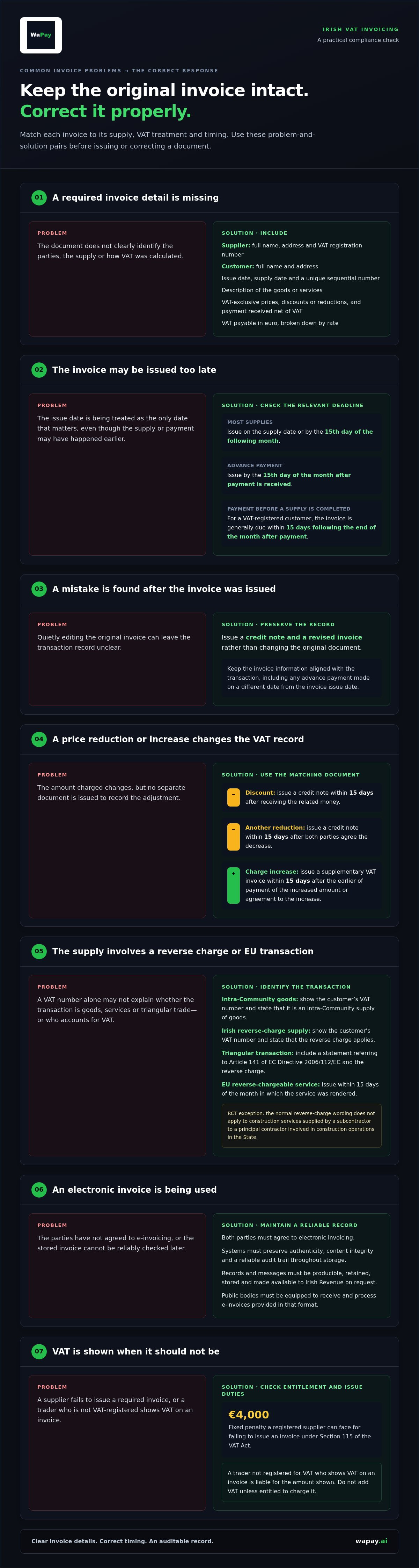
The Irish VAT invoice requirements specify the details needed to identify a supply and its VAT treatment. An invoice must show its issue date, a unique sequential number and the date the goods or services were supplied. It must identify the supplier and customer, describe the goods or services, and show VAT-exclusive prices, discounts or reductions, payment received net of VAT, and VAT payable in euro. It should also break down VAT by rate.
An accountable person issues a VAT invoice to record a taxable supply, including the details required by VAT law. If you are required to issue one, make sure its information matches the transaction, including any advance payment made on a different date from the invoice issue date.
For most supplies, issue the invoice on the supply date or no later than the 15th day of the following month. Issue invoices promptly and check the applicable timing requirements for the transaction. For an advance payment, issue the VAT invoice by the 15th day of the month after payment is received. Where payment arrives before a supply is completed for a VAT-registered customer, the invoice is generally due within 15 days following the end of the month after payment was received.
Credit notes and supplementary invoices have separate 15-day deadlines. Issue a credit note for a discount within 15 days after receiving the related money. For another reduction, issue it within 15 days after both parties agree the decrease. If the charge increases, issue a supplementary VAT invoice within 15 days after the earlier of payment of the increased amount or agreement to the increase.
Electronic invoices are permitted under Sections 66(2) and 66(2A) of the VAT Act and Regulation 21 of the VAT Regulations 2010. Both parties must agree to electronic invoicing, and their systems must preserve the invoice’s authenticity, content integrity and reliable audit trail throughout storage. Records and messages must be producible, retained, stored and made available to Irish Revenue on request. Public bodies must be equipped to receive and process e-invoices provided in that format.
A registered supplier that fails to issue an invoice under Section 115 of the VAT Act can face a fixed penalty of €4,000. A trader not registered for VAT who shows VAT on an invoice is liable for the amount shown. Treat these Irish VAT invoice requirements as a practical check before issuing, and don’t add VAT unless you’re entitled to charge it.
Reverse-charge and intra-Community supply invoices
For these transactions, make the cross-border supply or reverse-charge treatment clear on the invoice. Include the customer’s VAT registration number where required, and use wording that accurately describes the transaction.
Cross-border and reverse-charge transactions
An intra-Community supply is a qualifying supply between EU Member States. In a reverse-charge supply, the customer accounts for the VAT. For an Irish intra-Community supply of goods, show the customer’s VAT number and state that the transaction is an intra-Community supply of goods. Invoices for intra-Community supplies and certain reverse-charge supplies may require the customer’s VAT number, so identify the transaction before issuing the document.
For an Irish supply subject to the reverse charge, show the customer’s VAT number and state that the reverse charge applies. This tells the customer how to account for VAT and helps both parties keep transaction records aligned. A reverse-chargeable service supplied by a taxable person located in the EU has a specific invoice deadline: issue it within 15 days of the month in which the service was rendered.
Reverse-charge invoice wording
Reverse-charge wording is a clear statement on the invoice that the customer must account for VAT under the reverse-charge mechanism. Add it alongside the customer’s VAT registration number where the rule applies. For a triangular transaction, include a statement referring to Article 141 of EC Directive 2006/112/EC and the reverse charge. That reference identifies the treatment used for the transaction.
Construction services under Ireland’s Relevant Contracts Tax system are an exception to the normal reverse-charge notation. From 1 September 2008, construction services supplied by a subcontractor to a principal contractor involved in construction operations in the State are accounted for on a reverse-charge basis. The relevant operations are defined by Section 530 of the Taxes Consolidation Act 1997, but the normal reverse-charge wording does not apply to these RCT services.
Make sure the invoice description matches the actual supply. For example, an invoice for qualifying EU goods should identify them as an intra-Community supply, rather than relying on a VAT number alone. The customer’s VAT number does not explain whether the transaction concerns goods, services or triangular trade. Record the correct classification so both parties can match the invoice to the supply.
Check the transaction type before issuing: domestic reverse charge, intra-Community goods, reverse-charge services or triangular trade. Then include the applicable customer VAT number and wording. For routine invoice management, keep each document connected to its supply and payment records.
What information is required on a VAT invoice?
A complete invoice identifies both parties and clearly sets out the supply, charges and VAT. These fields link the document to the transaction and its tax treatment.
Supplier and customer details
For an Irish VAT invoice, identify the supplier by full name, address and VAT registration number, and the customer by full name and address. This makes it easier to match the invoice with business records. The customer’s VAT number is not a general requirement for an ordinary domestic supply, although it may be required for EU transactions.
Full invoice information
A full invoice must state its issue date and unique sequential number, as well as the date of supply. Describe the quantity and nature of goods, or the extent and nature of services. Show the VAT-exclusive unit price, any payment received net of VAT, and any discounts or price reductions. Then state the VAT payable in euro and break it down by VAT rate.
Format the invoice so each figure is easy to follow. List each item or service with its unit price, then show the applicable VAT rate and total VAT. Distinguish the amount before VAT from the tax charged, so the customer can see how you calculated the total instead of having to interpret one unexplained gross figure.
If an advance payment was made on a different date from the invoice issue date, include the payment date as well as the supply date. For an invoice in a foreign currency, also show the corresponding figures in euro. Use the Central Bank selling rate recorded when the invoice is due to be issued, and state VAT amounts in euro.
Some transactions require additional invoice details. For an intra-Community supply of goods, include the customer’s VAT number and state that the supply is an intra-Community supply of goods. This identifies the cross-border transaction. A customer’s registration number is not a general requirement for every domestic sale, but it matters for these EU supplies.
For a triangular transaction, include a statement referring to Article 141 of EC Directive 2006/112/EC and the reverse charge. If a tax representative is liable to pay VAT in another Member State, include that representative’s full name, address and Member State VAT number. These details connect the invoice to the correct party and VAT treatment.
Keep credit notes separate from the original invoice. If a transaction’s value changes, make the adjustment clear and traceable to the relevant supply. Before issuing each document, check names, dates, amounts and VAT treatment against the transaction.
Simplified invoices and the €100 threshold
A simplified VAT invoice can reduce paperwork for eligible Irish transactions. Whether you can use one depends on the amount and type of supply, not simply on whether the customer is a business or consumer.
Simplified invoice eligibility
In Ireland, a simplified VAT invoice is generally permitted when the invoice amount does not exceed €100. It cannot be used for intra-Community supplies of goods or services, even when the amount is below that limit. Identify the supply first, then consider the invoice amount. That keeps the threshold from being mistaken for a blanket exemption from standard invoice rules.
A simplified invoice must show the issue date, the supplier’s full name, address and VAT registration number, and a description of the goods or services. It must also show either the tax payable or the price exclusive of tax. These details help the customer identify the supplier, understand the supply and see the relevant charge.
The simplified invoice threshold
The €100 ceiling applies to the amount on the invoice. An invoice at exactly €100 is within the stated limit; one above €100 is not. Where a transaction exceeds the ceiling, use a full VAT invoice with its required details rather than relying on the shorter simplified format.
Customer type matters separately. A VAT invoice is generally not required for a delivery to a private consumer, while a VAT-registered business customer may need an invoice to support its VAT records. However, the €100 simplified-invoice rule does not make every small business sale eligible: an intra-Community supply of goods or services remains excluded.
VAT-free supplies are generally outside the usual requirement to issue a VAT invoice. A supplier that is not VAT registered should not issue an invoice showing VAT. These are separate points: the simplified-invoice threshold applies to eligible invoices, while the customer and supply determine whether an invoice is generally required.
Use this check before choosing the format:
- Confirm whether the supply is domestic or intra-Community.
- Check whether the amount is no more than €100.
- For an eligible simplified invoice, include the supplier’s VAT registration number and the issue date.
- Describe the goods or services, then show tax payable or the price exclusive of tax.
For example, a domestic supply invoiced at €100 may fit the simplified format if its required details are present. An intra-Community service at the same amount cannot use that format. The transaction type, not just the amount or customer category, decides which invoice form applies.
Mandatory fields on a full Irish VAT invoice
The Irish VAT invoice requirements provide a clear framework for documenting each taxable supply. A full invoice identifies both parties, explains what was supplied and shows how the VAT figure was calculated. Use the fields below as a practical check before issuing an invoice.
- Supplier: state the supplier’s full name, address and VAT number.
- Customer: include the customer’s full name and address.
- Reference: show the invoice issue date and a unique sequential number.
- Supply: state the supply date and describe the quantity and nature of goods, or the extent and nature of services.
- Prices: show the VAT-exclusive unit price, payment received net of VAT, and any discounts or reductions.
- VAT: show the breakdown by VAT rate and total VAT payable in euro.
Make the figures easy to follow. If an invoice covers items with different VAT rates, separate them by rate and show the VAT payable for each group. For example, list each item’s quantity and unit price before showing the relevant rate and subtotal. This gives the customer a clear calculation instead of one combined figure without a visible breakdown.
For an invoice in a foreign currency, also show the corresponding figures in euro. Use the Central Bank selling rate recorded when the invoice is due to be issued. Revenue may agree to an alternative exchange-rate method, but it must apply to all the business’s foreign-currency transactions. VAT amounts must still be stated in euro.
Special schemes require the relevant endorsement. An invoice for goods supplied under the margin scheme must include the wording “Margin scheme, second-hand goods”. For supplies under the margin scheme, the special scheme for auctioneers or the special scheme for second-hand motor vehicles, identify the scheme that applies. A general VAT breakdown does not replace this scheme reference.
Keep the supply date distinct from the invoice date, and record the date of any advance payment made on a different day. Retain VAT invoices, credit notes and supporting records for six years, keeping related documents together with the relevant transaction.
Use Irish VAT invoice requirements as a final check against the actual supply: confirm the names, sequence number, description, prices and VAT treatment. Create and manage business invoices as part of a more organised invoicing routine.
WaPay: Payments
WaPay helps make routine invoicing a quicker part of the working day. Create invoices and payment links from a voice note or text message through WhatsApp or its WebApp, then keep payment reminders and VAT records connected to your business activity. Customer payments go directly to your business bank account.
WaPay is a practical fit when you want to invoice promptly after a job, keep payment details connected to the invoice and reduce admin between bookings. It also provides a live business dashboard, with no subscription or app download required. WaPay supports the day-to-day flow of invoices and payments, while VAT decisions and tax filing remain your responsibility.
Visit wapay.ai to see how WaPay can fit your invoicing and payment routine.
Make clear invoicing part of the working day
Invoice habits are easier to maintain when they fit naturally into the job. Capture transaction details while they’re fresh, keep each document connected to its payment, and make corrections openly. A simple routine like this helps prevent paperwork from piling up until the end of the day.
Meeting Irish VAT invoice requirements is one part of keeping business records clear. Build a consistent process for issuing invoices, tracking payments and filing related documents. For an unusual transaction, establish the correct VAT treatment before issuing the invoice. An organised workflow supports your records, but it does not replace tax advice or filing.
WaPay offers Invoices, Payments and Bills to help organise everyday business administration. Use it to keep routine tasks moving alongside your work, without treating an invoicing tool as a substitute for deciding which VAT rules apply.
Take the next step at your own pace. Contact WaPay about VAT invoices and explore a simpler way to handle the admin around your work.
Frequently Asked Questions
Can you edit a VAT invoice after issuing it?
Don’t quietly overwrite an issued invoice. Correct it with a credit note and a revised invoice to leave a clear trail of the original charge and its correction. For example, if a service line was entered incorrectly, explain the adjustment in the credit note, then issue the corrected document. Keep both records together so the customer can see what changed and why.
Do I put VAT on my invoices if I'm not VAT registered?
No. Don’t add VAT to an invoice if you aren’t registered to charge it. An Irish trader who is not VAT registered but shows VAT on an invoice becomes liable for the VAT amount displayed. For example, an invoice that separates a net charge from a VAT figure can create a liability for that stated tax. Keep the amount charged clear and don’t label any part as VAT.
When do you have to issue a VAT invoice?
For a typical supply, issue the invoice on the supply date or by the 15th day of the following month. An advance payment has its own timing rule, so record when the payment arrived as well as when the supply occurred. For example, if a customer pays before work is completed, the payment date helps determine the invoice deadline and the VAT point.
Can I use a simplified VAT invoice?
Yes, for an eligible invoice amount of €100 or less, but not for an intra-Community supply of goods or services. A simplified invoice needs the supplier’s name, address and VAT registration number, its issue date, a description of the supply, and either tax payable or the price before tax. For example, a low-value domestic transaction may qualify, while a similarly priced EU supply does not.
How do you show mixed VAT rates on one invoice?
Show charges and VAT separately for each applicable rate, then make the total VAT payable clear. For example, if an invoice includes two types of goods taxed at different rates, give each group its own line or subtotal rather than combining them under one rate. This shows the customer how you calculated the total and helps keep the invoice aligned with the sale.
What information must an Irish VAT invoice include?
A full invoice should identify the parties, supply, amount charged and VAT treatment without leaving the reader to guess. Include the supplier’s VAT number and the customer’s name and address, and distinguish the issue date from the supply date. Before sending it, compare the invoice with the job or order: the description, quantity and charge should match what you supplied.
When must a VAT invoice be issued in Ireland, and what are the deadlines?
For most supplies, issue the invoice on the supply date or by the 15th day of the next month. Invoices for intra-Community supplies and certain reverse-charge services have a 15-day deadline tied to the month the supply was made. Advance payments also affect timing. Record the date payment was received, since it can determine the invoice deadline before the goods or services are provided.
What are the rules for simplified VAT invoices and receipts in Ireland?
A simplified VAT invoice may be used for an eligible amount of €100 or less, but not for intra-Community supplies. It must identify the supplier, show its VAT registration number and issue date, describe the supply, and state either tax payable or the price excluding tax. A VAT invoice is generally not required for a delivery to a private consumer; don’t treat that as permission to show VAT if you’re unregistered.
Frequently asked questions
Can you edit a VAT invoice after issuing it?
Don’t quietly overwrite an issued invoice. Correct it with a credit note and a revised invoice to leave a clear trail of the original charge and its correction. For example, if a service line was entered incorrectly, explain the adjustment in the credit note, then issue the corrected document. Keep both records together so the customer can see what changed and why.
Do I put VAT on my invoices if I'm not VAT registered?
No. Don’t add VAT to an invoice if you aren’t registered to charge it. An Irish trader who is not VAT registered but shows VAT on an invoice becomes liable for the VAT amount displayed. For example, an invoice that separates a net charge from a VAT figure can create a liability for that stated tax. Keep the amount charged clear and don’t label any part as VAT.
When do you have to issue a VAT invoice?
For a typical supply, issue the invoice on the supply date or by the 15th day of the following month. An advance payment has its own timing rule, so record when the payment arrived as well as when the supply occurred. For example, if a customer pays before work is completed, the payment date helps determine the invoice deadline and the VAT point.
Can I use a simplified VAT invoice?
Yes, for an eligible invoice amount of €100 or less, but not for an intra-Community supply of goods or services. A simplified invoice needs the supplier’s name, address and VAT registration number, its issue date, a description of the supply, and either tax payable or the price before tax. For example, a low-value domestic transaction may qualify, while a similarly priced EU supply does not.
How do you show mixed VAT rates on one invoice?
Show charges and VAT separately for each applicable rate, then make the total VAT payable clear. For example, if an invoice includes two types of goods taxed at different rates, give each group its own line or subtotal rather than combining them under one rate. This shows the customer how you calculated the total and helps keep the invoice aligned with the sale.
What information must an Irish VAT invoice include?
A full invoice should identify the parties, supply, amount charged and VAT treatment without leaving the reader to guess. Include the supplier’s VAT number and the customer’s name and address, and distinguish the issue date from the supply date. Before sending it, compare the invoice with the job or order: the description, quantity and charge should match what you supplied.
When must a VAT invoice be issued in Ireland, and what are the deadlines?
For most supplies, issue the invoice on the supply date or by the 15th day of the next month. Invoices for intra-Community supplies and certain reverse-charge services have a 15-day deadline tied to the month the supply was made. Advance payments also affect timing. Record the date payment was received, since it can determine the invoice deadline before the goods or services are provided.
What are the rules for simplified VAT invoices and receipts in Ireland?
A simplified VAT invoice may be used for an eligible amount of €100 or less, but not for intra-Community supplies. It must identify the supplier, show its VAT registration number and issue date, describe the supply, and state either tax payable or the price excluding tax. A VAT invoice is generally not required for a delivery to a private consumer; don’t treat that as permission to show VAT if you’re unregistered.