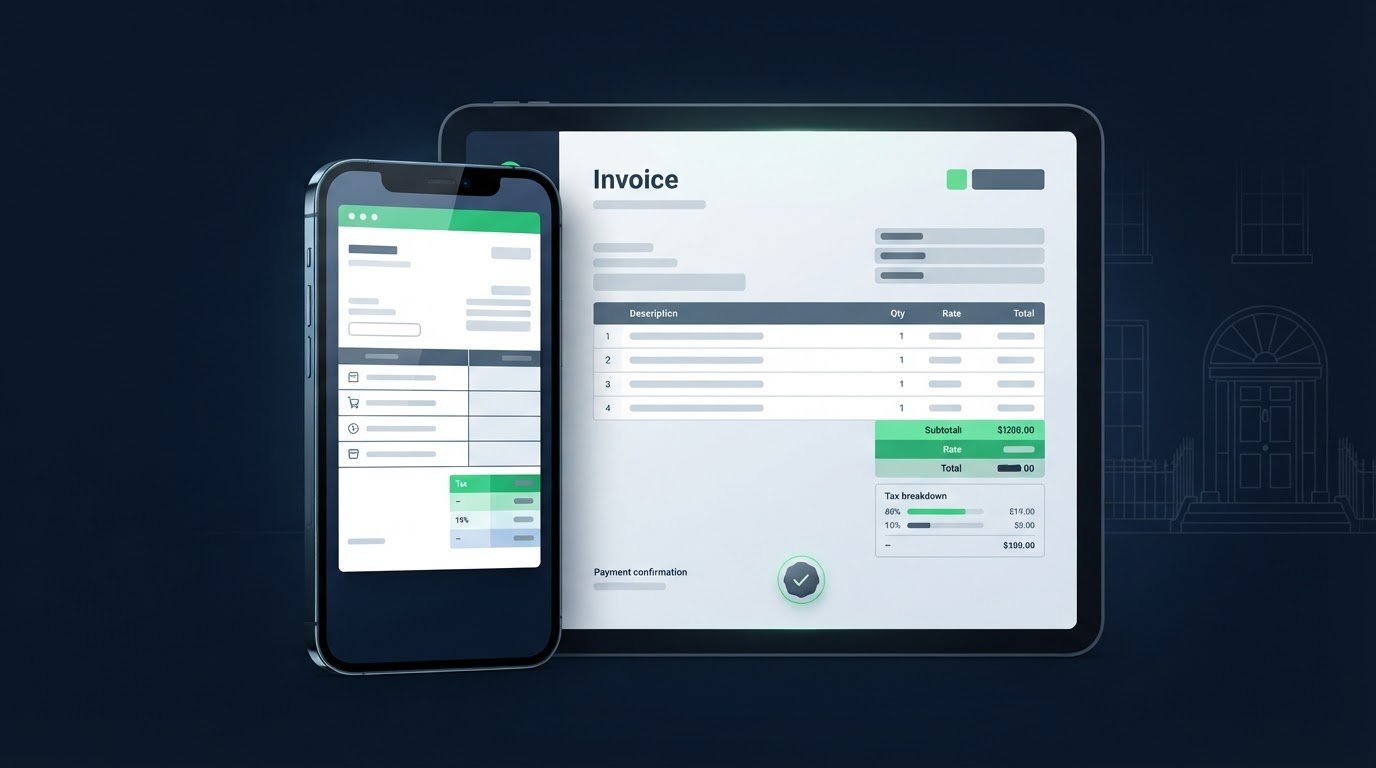
A VAT-compliant invoice template for Ireland must show the invoice date and a unique sequential number, the supplier’s name, address and VAT registration number, and the customer’s name and address. It must also give the supply date, describe the goods or services, and break down the prices, discounts and VAT payable by rate. The standard VAT rate is 23%.
Getting the details right makes the charge clear and gives you a useful record of the work supplied. Invoicing can feel like one more task after a long day, but a consistent layout makes each invoice easier to prepare. This guide covers the required details, how to describe goods and services, and how to show prices, discounts and VAT. It also explains when special wording applies, so you can choose a template that fits the sale and clearly show your customer how the figures add up.
Key Takeaways
- Keep invoice records in sequence, and include the supply date as well as the issue date when they differ.
- Describe goods by their quantity and nature; for services, make the work carried out clear.
- Show discounts and price reductions before setting out the VAT breakdown, using the rate that applies to each supply.
- Use WaPay to create invoices and payment links from a voice note or text, helping move admin towards payment.
Table of Contents
VAT invoice details for goods and services
An Irish VAT invoice records the sale, the parties involved and the VAT due. Some cross-border transactions require additional fields or wording.
Required invoice details
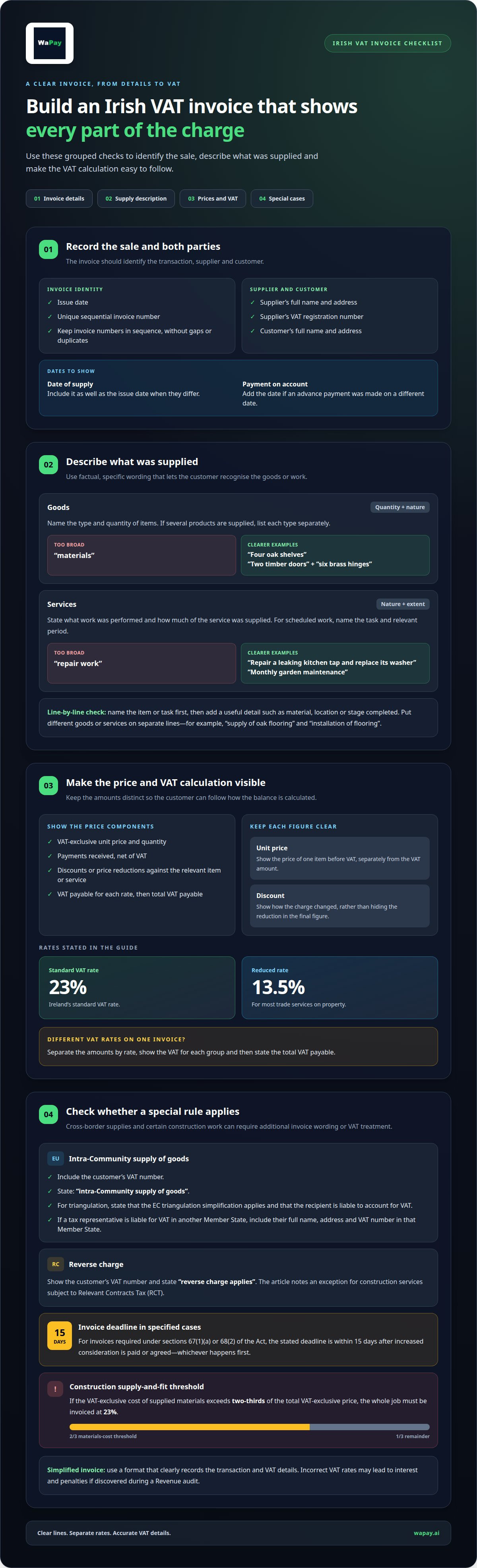
A VAT invoice records a taxable supply and its VAT details. Include the issue date, a unique sequential invoice number, the supplier’s full name, address and VAT registration number, and the customer’s full name and address. Add the date of supply and, if an advance payment was made on a different date, the payment-on-account date. Keep invoice numbers in sequence, without gaps or duplicates.
Intra-Community supply details
An intra-Community supply is a supply of goods between EU Member States. For these goods, include the customer’s VAT number and state that the invoice concerns an “intra-Community supply of goods”. According to the Office of the Attorney General, an accountable person must issue an invoice for each supply to a person in another EU Member State who is liable for VAT under the VAT Directive.
For a triangulation transaction, state that the EC triangulation simplification applies and that the recipient is liable to account for VAT. If a tax representative is liable for VAT in another Member State, include their full name, address and VAT number in that Member State.
An Irish business must issue an invoice for a qualifying supply to a person in another EU Member State who is liable for VAT under the VAT Directive. For invoices required under sections 67(1)(a) or 68(2) of the Act, the Office of the Attorney General states the deadline is within 15 days after increased consideration is paid or agreed, whichever happens first.
For a reverse-charge supply, show the customer’s VAT number and state “reverse charge applies”. There is a stated exception for construction services subject to Relevant Contracts Tax (RCT).
For a simplified invoice, use a format that clearly records the transaction and VAT details. The full fields above offer a practical reference when deciding what to include.
Incorrect VAT rates may lead to interest and penalties if discovered during a Revenue audit. A downloadable Irish invoice template is available as a Microsoft Word 97-2003 document, 164 KB.
Goods and services descriptions
A goods description identifies the type and quantity of items supplied. An Irish VAT invoice must state the quantity and nature of the goods. “Four oak shelves” gives the customer a clearer record than “materials”. If you supply several products, list each type separately, such as “two timber doors” and “six brass hinges”. This links each invoice line to the goods delivered.
A service description states what work was performed and the extent of the service supplied. An Irish VAT invoice must show the extent and nature of services rendered. “Repair work” is broad; “repair a leaking kitchen tap and replace its washer” identifies the task. For a scheduled service, name the work and relevant period, such as “monthly garden maintenance”.
Check each line by asking whether the customer could recognise the goods or work from the wording alone. Name the item or task first, then add a useful detail, such as the material, location or stage completed. For example, replace “labour” with “install kitchen wall units”. Keep each description factual and specific to the supply.
If one invoice covers different goods or services, list them on separate lines. A fitting job might show “supply of oak flooring” and “installation of flooring” separately. This makes each part of the job easier to understand. Match every line to the work completed or goods delivered instead of relying on a broad label such as “project”.
Prices, discounts and VAT breakdown
A VAT breakdown shows the taxable amount and VAT payable for each rate. On an Irish invoice, show the VAT-exclusive unit price, payments received net of VAT, discounts or price reductions, and total VAT payable. Keep the figures distinct so the customer can follow how the balance is calculated.
A VAT-exclusive unit price is the price of one item before VAT. Show it separately from the VAT amount rather than giving only a combined price. For example, list each product’s unit price and quantity, then show the applicable VAT rate and line total. This makes it easier to distinguish items charged at different rates.
A discount reduces the selling price. Show discounts or price reductions against the relevant item or service so the customer can see how the charge changed. If you have received a payment, record the amount net of VAT. Keep these figures separate from the final VAT payable.
The VAT rate is the percentage applied to a taxable supply. Ireland’s standard VAT rate is 23%; the reduced rate for most trade services on property is 13.5%. If an invoice covers supplies at different rates, separate the amounts by rate and show the VAT for each group. Then state the total VAT payable.
For subcontracting under Relevant Contracts Tax (RCT), the invoice is usually subject to the reverse charge, so no VAT is added. For a supply-and-fit job, if the VAT-exclusive cost of supplied materials exceeds two-thirds of the total VAT-exclusive price, the whole job must be invoiced at 23%. These distinctions affect the VAT calculation, not just the invoice layout.
WaPay: Payments
WaPay helps you turn completed work into an invoice and payment request. Create invoices and payment links from a voice note or text message through WhatsApp or the WebApp, and keep VAT records alongside your business activity. You can also use payment reminders to follow up on unpaid invoices.
This can suit sole traders who want to manage admin between jobs rather than rebuild each invoice from scratch. WaPay has no subscription and no app to download. Customer payments go directly to your business bank account. Make sure every invoice reflects the correct VAT treatment for the supply: organised records support your admin, but accurate invoice details still matter.
Visit WaPay to explore its invoice tools.
Make invoicing part of a smoother routine
A VAT-compliant invoice template for Ireland is most useful when it supports a clear process, from recording completed work to following up on payment. Set a routine for recording each job and collecting what customers owe. Keeping the steps manageable can help you stay on top of paperwork after a busy day.
WaPay brings Invoices, Payments and Bills into everyday business administration. If you want to manage invoicing and payments in one workflow, explore WaPay and see how it fits the way you run your business. A consistent process helps you move from finished work to the next job without leaving paperwork until later.
Make your next admin task simpler with a process that keeps your business moving.
A routine that works for you helps you finish the paperwork and focus on what’s next.
Frequently Asked Questions
What information is required on a VAT invoice?
A VAT invoice records who supplied the goods or service, who received it and the VAT charged. A VAT-compliant invoice template for Ireland should also leave room for additional wording where a transaction requires it. For foreign-currency invoices, check whether additional currency details are needed and use an appropriate exchange-rate method.
What information must an Irish VAT invoice include?
Include the details that identify the supplier, customer and transaction, then add wording for any special VAT treatment. For example, an invoice for second-hand goods under the margin scheme needs the relevant endorsement. Auction goods under that scheme require different wording, so use the endorsement that matches the sale.
How should Irish VAT invoices show VAT rates and amounts?
Show the VAT-exclusive amount and VAT due separately for each applicable rate. If a sale includes items taxed at different rates, group or label the lines so each rate and its VAT amount can be traced. This helps the customer understand the total without mistaking it for the VAT-exclusive price.
How do I create a VAT-compliant invoice in Ireland step by step?
Choose a VAT compliant invoice template Ireland sole traders can use repeatedly, then fill it in for each sale. Record the parties and dates, describe each supply, enter the price and any discount, and show the VAT calculation. Before sending, check that any special wording matches the transaction and save a copy with your records.
What details are required on simplified VAT invoices in Ireland?
Use a format that clearly records the transaction and VAT details. The full invoice fields, including supplier and customer details, invoice and supply dates, a description of the supply and a VAT breakdown, provide a practical reference.
Frequently asked questions
What information is required on a VAT invoice?
A VAT invoice records who supplied the goods or service, who received it and the VAT charged. A VAT-compliant invoice template for Ireland should also leave room for additional wording where a transaction requires it. For foreign-currency invoices, check whether additional currency details are needed and use an appropriate exchange-rate method.
What information must an Irish VAT invoice include?
Include the details that identify the supplier, customer and transaction, then add wording for any special VAT treatment. For example, an invoice for second-hand goods under the margin scheme needs the relevant endorsement. Auction goods under that scheme require different wording, so use the endorsement that matches the sale.
How should Irish VAT invoices show VAT rates and amounts?
Show the VAT-exclusive amount and VAT due separately for each applicable rate. If a sale includes items taxed at different rates, group or label the lines so each rate and its VAT amount can be traced. This helps the customer understand the total without mistaking it for the VAT-exclusive price.
How do I create a VAT-compliant invoice in Ireland step by step?
Choose a VAT compliant invoice template Ireland sole traders can use repeatedly, then fill it in for each sale. Record the parties and dates, describe each supply, enter the price and any discount, and show the VAT calculation. Before sending, check that any special wording matches the transaction and save a copy with your records.
What details are required on simplified VAT invoices in Ireland?
Use a format that clearly records the transaction and VAT details. The full invoice fields, including supplier and customer details, invoice and supply dates, a description of the supply and a VAT breakdown, provide a practical reference.